
GMRS for Families: One $35 License, Radios for the Whole Family
One GMRS license covers your spouse, kids, parents, siblings and in-laws, with no exam. Here's what it allows, which radios to buy, and how to turn it into a real family plan with DexNet.
When the cell network goes down, the first thing everyone wants to know is simple: is my family OK? A text that never sends doesn't answer that. A radio does. If you only make one radio decision for your household, make it GMRS.
GMRS (General Mobile Radio Service) sits between the blister-pack FRS radios from the big-box store and full amateur radio. It uses the same channels as FRS, but with more power, better antennas and access to repeaters. And one license covers your whole family, with no test.
What one license gets you
The FCC rules for GMRS are in Part 95, Subpart E. The short version:
- Cost and term: a $35 application fee, and the license is good for ten years.
- No exam. You apply online and pay the fee. That's it.
- You must be 18 or older to get the license.
- Your family can operate under it. The rule (47 CFR 95.1705) lists "the licensee's spouse, children, grandchildren, stepchildren, parents, grandparents, stepparents, brothers, sisters, aunts, uncles, nieces, nephews, and in-laws." There's no rule that they have to live with you, and no minimum age for family members to talk on your radios.
- Anyone can use it in an emergency. You may let anyone operate your station "if necessary to communicate an emergency message."
- You're responsible. The licensee decides which family members operate and answers for how the radios are used.
Compare that to ham radio, where every person who transmits needs their own license and exam. For a family with kids and grandparents, GMRS is the fastest way to get everyone on the air legally.
How to get licensed
- Register for an FCC Registration Number (FRN) in the FCC's CORES system.
- Log in to the FCC's Universal Licensing System (ULS) and apply for a new license in the General Mobile Radio Service (ZA).
- Pay the $35 fee.
- Watch your email for your call sign. Write it down, and put it on a label on every radio.
FRS vs. GMRS in one minute
There are 22 shared channels, and the power you can use depends on the channel:
- Channels 1–7 (462 MHz): up to 5 watts ERP on GMRS, 2 watts on FRS.
- Channels 8–14 (467 MHz): handhelds only, 0.5 watt ERP. Short range; avoid them for your family plan.
- Channels 15–22 (462 MHz): up to 50 watts for GMRS mobiles and base stations (2 watts on FRS). This is where your best range is.
- Repeater channels (15R–22R): your radio transmits on 467 MHz and a repeater on a hill or tower retransmits you on the matching 462 MHz channel. A good repeater can turn a few miles into a few dozen.
Your licensed GMRS radios can talk with your family's FRS radios on the shared channels, so the cheap pair in the junk drawer still has a place in the plan.
One myth to bust: a "privacy code" (CTCSS/DCS tone) isn't private. It only stops your radio from hearing other people. Anyone without a tone set hears everything you say.
Picking radios
- Buy FCC-certified GMRS radios. Many cheap dual-band ham radios are not certified for GMRS. Look for "GMRS" and Part 95 certification on the box or in the listing.
- Handhelds for every family member. Easy to carry, but expect a mile or two in a neighborhood, less inside buildings.
- A mobile radio in the car and a base station at home with an outside antenna. Antenna height matters more than watts: a 15-watt radio with an antenna on the roof beats a 50-watt radio with its antenna in the basement.
- Batteries. Get a spare pack or an AA battery shell for each handheld, and a way to charge from the car or a power station.
- Test before you need it. Find out how far you can actually reach from home to school, work and the grandparents' house.
The rules your family should know
- Say the call sign. At the end of a conversation, and at least every 15 minutes during a long one, in English (47 CFR 95.1751). Family members use your call sign; you can add a unit number, like "[your call sign] unit 2."
- Plain language. No coded messages or hidden meanings (10-codes are allowed), no music, no advertising.
- Emergencies come first, on every channel, every time.
- Text and location are OK. Handhelds may send GPS location and short text messages to another GMRS or FRS radio, which is handy with the newer GPS-equipped models.
- Repeaters belong to someone. Ask the owner before you use one, and record its channel and tone. The myGMRS.com directory is a good place to find local repeaters and owners.
- Channel 20 with a 141.3 Hz tone is a common informal travel and emergency channel. It's a community custom, not an FCC rule, but worth monitoring.
Turn radios into a plan with DexNet
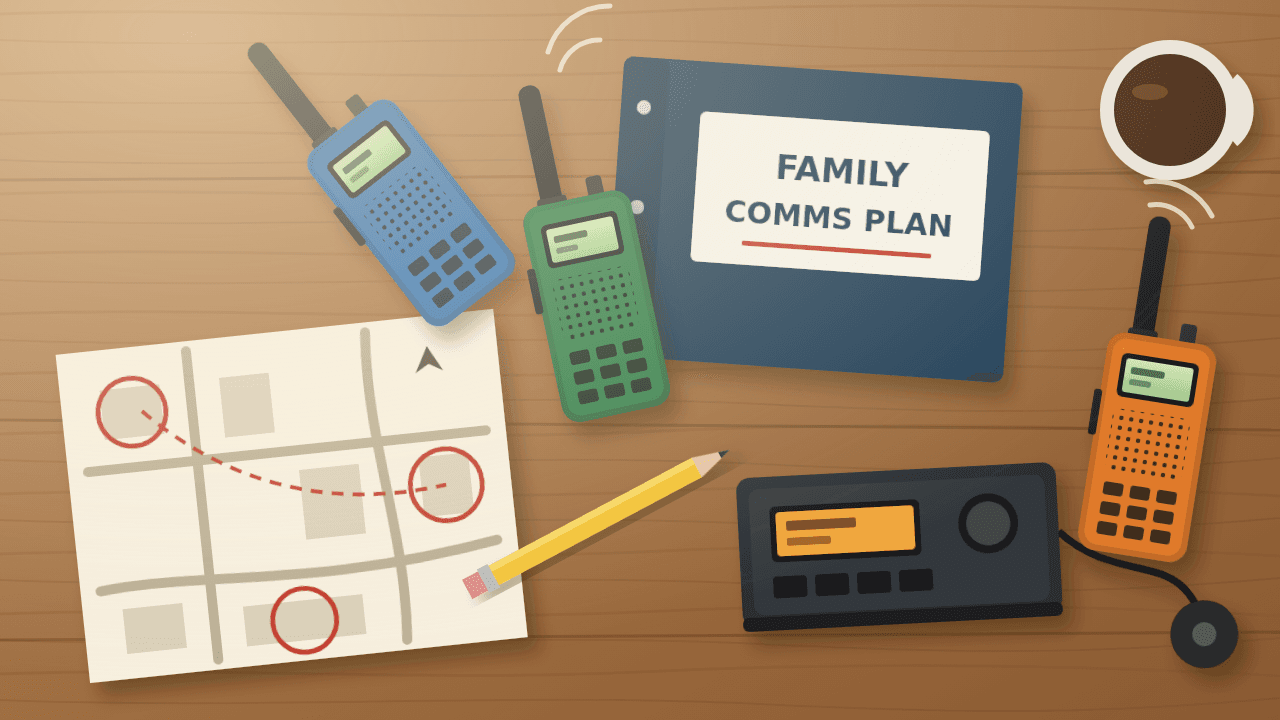
Radios without a plan are just walkie-talkies. When something happens, everyone needs to know which channel, what time, and what to say. That's what DexNet is for. It's my free, printable family and neighborhood communications plan, and the GMRS page has blanks for exactly what this post covers:
- GMRS call sign, channel and repeater (with its input and output tones), plus an FRS backup channel for anyone with a blister-pack radio.
- A PACE plan: Primary, Alternate, Contingency, Emergency. For most families, GMRS simplex is a great Primary, a local GMRS repeater the Alternate, and 2 m ham or a Meshtastic mesh the Contingency.
- A group roster with short tactical calls ("Home Base," "Truck 1," "Grandma's") so nobody has to remember names on the air.
- Activation rules: when cell, landline, internet or power fail, everyone turns their radio on at the top of the hour.
- A check-in format kids can follow: "Home Base, Dex, at the house, all OK, no traffic."
- An appendix with every FRS and GMRS channel, frequency and power limit, so you don't have to look it up when the lights are out.
Print it, sit down at the kitchen table, and fill it in together. Put a copy in every go-bag and next to every radio.
This week's to-do list
- Apply for your GMRS license ($35, ten years, no exam)
- Pick one primary channel and one backup, and test them from every place your family goes
- Label every radio with your call sign and the family channel
- Print DexNet and fill in the GMRS page and your PACE plan
- Run a five-minute family check-in on Sunday night, and do it again next week
When your family can find each other without a phone, you've solved the hardest part of any emergency.
73, KX3DEX
More in General
Prepping for Emergencies: What This Month’s Infrastructure Warnings Mean for Your Family
Federal agencies are warning about attacks on refrigeration, water and energy control systems. Here’s how to plan for multi-day outages, and keep talking when the phones don’t work.
Read post
How Amateur Radio points to a globe-shaped Earth
Ham radio isn’t “a proof” in the math-theorem sense, but it is a hands-on laboratory. With nothing more than common gear—an HF rig, a VHF/UHF radio, a simple antenna, and (optionally) an SDR—you can…
Read post
Planning Your Ham Shack: A Practical Guide
A good ham shack isn’t defined by how expensive your radio is it’s defined by how easy it is to operate, how quiet (RF-wise) it is, and how comfortable you can be for those “one more contact”…
Read post